
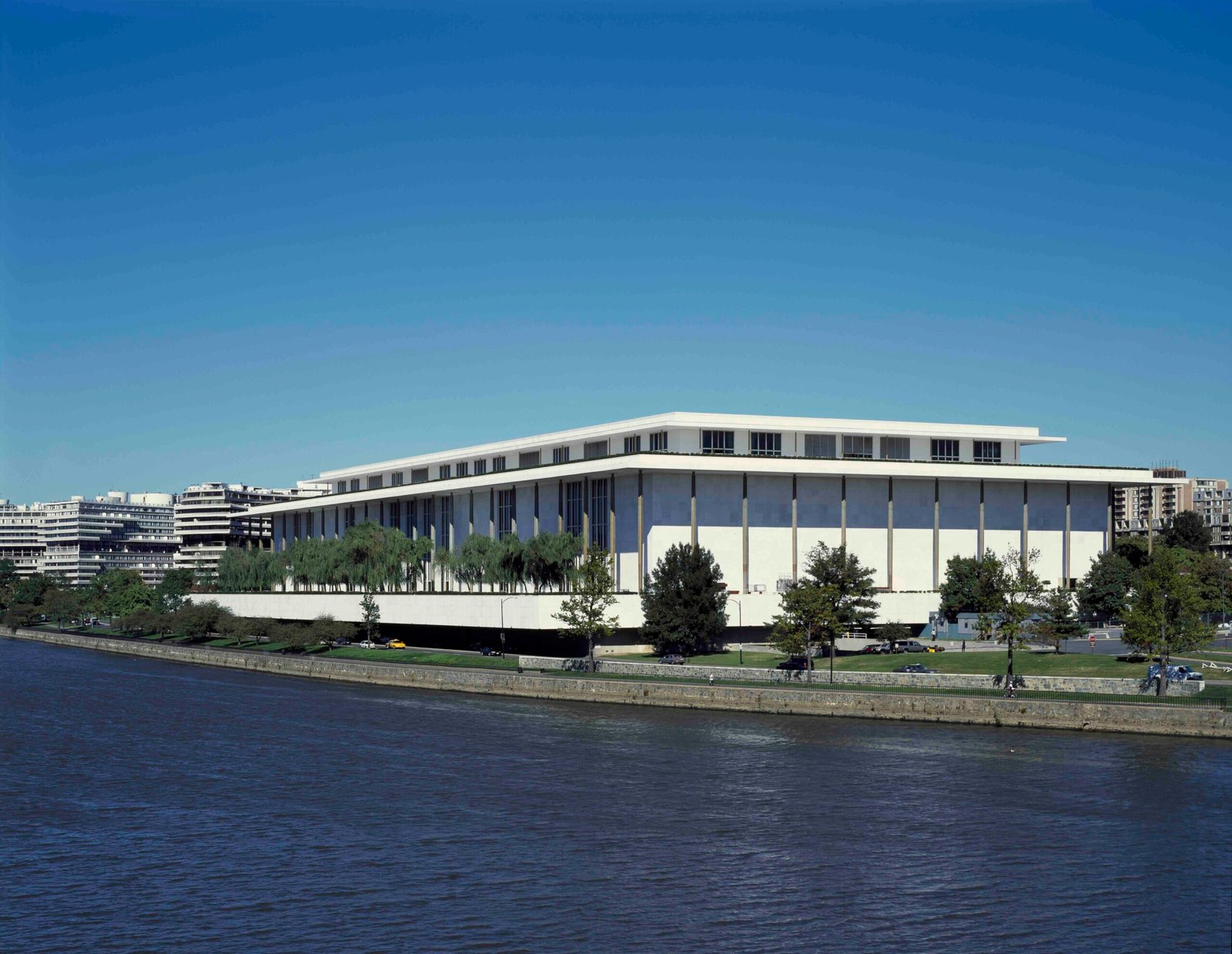
I have some wonderful memories associated with The John F. Kennedy Center for the Performing Arts. Over the last 25 years I have attended plays, musicals, and more. It was there when my first wife, Carolyn, was fighting cancer and needing a scooter if any kind of walking was involved, that we were able to enjoy a dinner in the restaurant and balcony seats designed to accommodate.
It was at the Kennedy Center that Rita and I had one of our first dates back in the summer of 2009. I’ve enjoyed Jerry Seinfeld, The Lion King, Wicked, The Book of Mormon, Jersey Boys, The King and I, and so much more. Almost always, we would treat ourselves to a wonderful “themed” dinner in the restaurant and enjoy the view from the rooftop terrace before being wonderfully entertained.

One of my favorite stories about the Center – I invited a friend of mine and his wife to go with us to see “Wicked”. Rita and I had seen it on Broadway, but it is a wonderful show (plus she fell asleep during the second act), so we were happy to go see the touring company.
It was the first time my friend had ever seen a live musical performance. We were living a few states away at the time, so it was over a year before we saw each other again. I was thrilled to hear that he had since attended two more musicals and had tickets for another.
That is what the Center was all about: opening up the world of the performing arts to not only the elites, but to all of the people of the United States.
All of that is at stake now because of one jealous and petty orangutan-like man-child. If I can paraphrase the famous Charlton Heston line from the movie The Planet of the Apes, “Take your stinking paws off the Kennedy Center, you damned dirt ape!”
Here’s the part that sticks in my craw. The President has said, more than once and with real conviction, that he found the Kennedy Center drowning in debt — ten million here, “hundreds of millions” there, and on one occasion, if you can believe it, “hundreds of billions.” I don’t know which number he woke up believing that morning, but I do know how to read a tax return, and so, apparently, does the Kennedy Center itself. Its own 2024 filing — the year before any of this leadership shuffle started — shows over $306 million in revenue and $558 million in net assets. That’s not an institution circling the drain. That’s an institution doing just fine, thank you, right up until somebody decided it needed saving from a crisis that didn’t exist.
Don’t believe me? Well, let’s take a look back at the Center and the man it honors.
Brief Biography of John F. Kennedy
John Fitzgerald Kennedy was born May 29, 1917, in Brookline, Massachusetts. He graduated from Harvard in 1940, wrote Why England Slept on Britain’s pre-war military unpreparedness, and served in the Navy during World War II, commanding PT-109 in the Pacific. When a Japanese destroyer rammed and sank his boat in August 1943, Kennedy helped save his surviving crew — towing one badly injured sailor for hours by gripping a strap in his teeth — earning the Navy and Marine Corps Medal and a Purple Heart.
After the war, he won election to the U.S. House of Representatives in 1946 and the Senate in 1952, and won a Pulitzer Prize in 1957 for Profiles in Courage. In 1960, at age 43, he became the youngest elected president and the first Catholic to hold the office. His administration navigated the Cuban Missile Crisis, launched the Peace Corps, and set the moon-landing goal, while Kennedy and Jacqueline Kennedy were also notable patrons of the arts. He was assassinated in Dallas on November 22, 1963, at the age of 46.
A Brief History of the Kennedy Center
Here’s something most people don’t know, including me until I started digging around for this post: the idea for a national cultural center wasn’t Kennedy’s to begin with. Congress kicked it off in 1958 under Eisenhower, of all people — not exactly a guy remembered for his love of the arts, but credit where it’s due. The trouble was, nobody could raise the money. It sat there, authorized but broke, until Kennedy — young, charming, and married to a woman who actually knew what a symphony was — decided to make it his personal project and put some star power behind the fundraising. Broadway producer Roger L. Stevens got the unenviable job of actually building the thing.
Then Kennedy was assassinated in November 1963, and Congress did something almost unheard of in government — they moved fast. Within months, they renamed the still-unbuilt building in his honor, calling it a “living memorial.” Not a statue. Not a plaque nobody reads. A place that would stay alive, doing what he loved, for as long as people kept showing up. I think that’s a better tribute than most of what Washington usually manages.
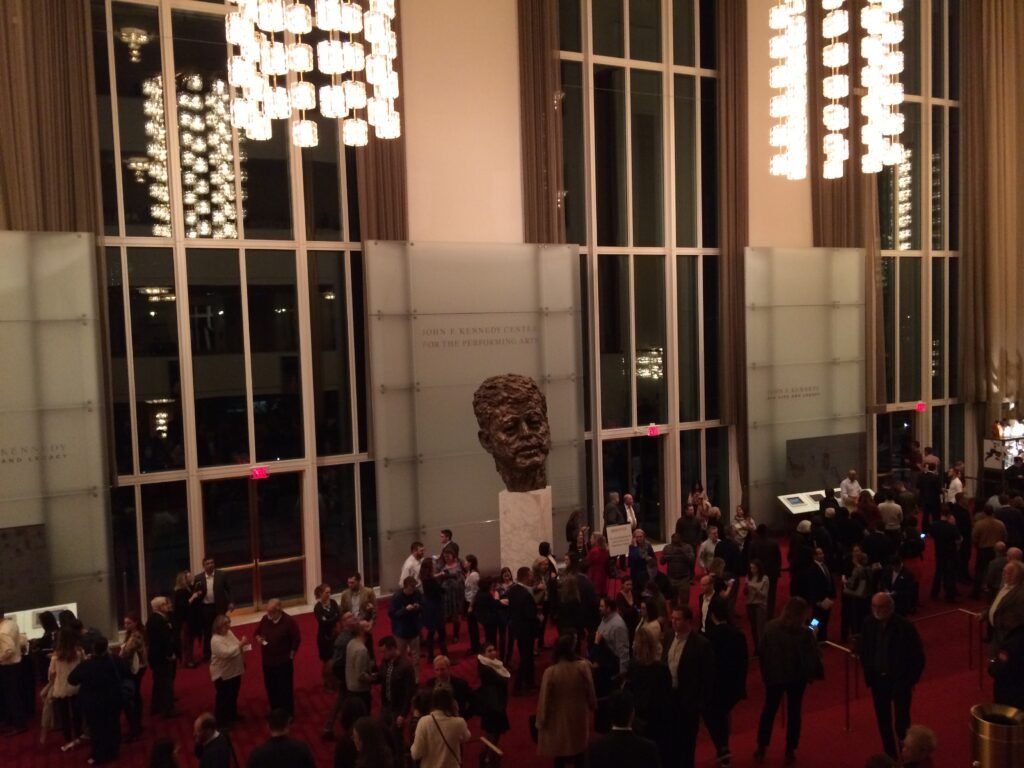
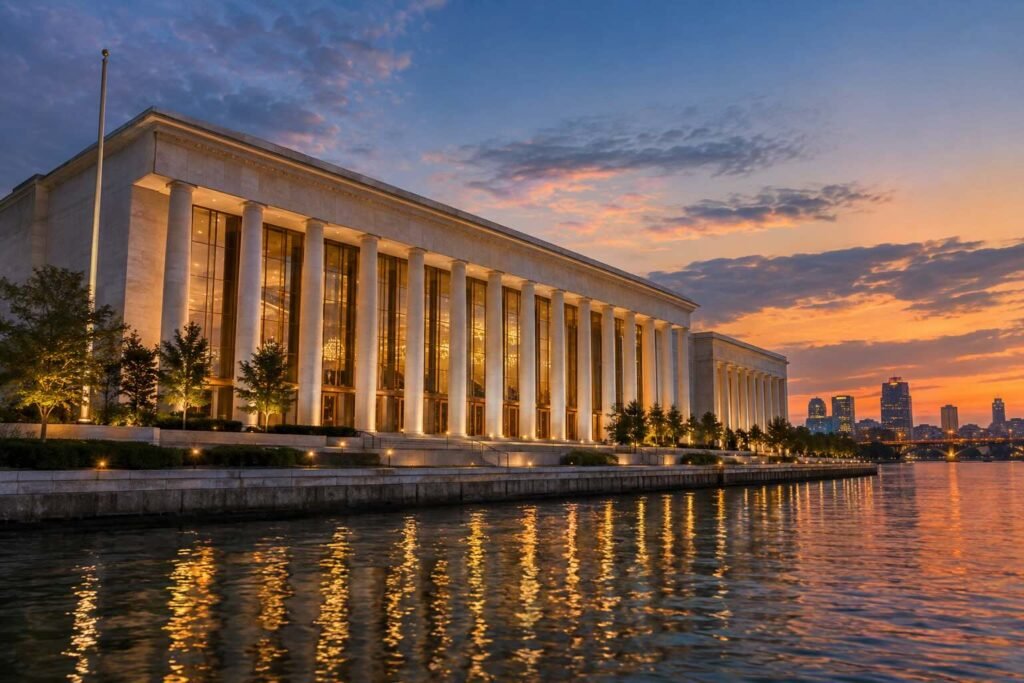
Ground broke, architect Edward Durell Stone did his thing, and the doors finally opened on September 8, 1971, sitting right on the Potomac like it owns the view (it kind of does). Walk into the Grand Foyer today and you’re standing under 18 crystal chandeliers, a gift from Sweden — because apparently even the Swedes wanted in on honoring the guy. The building holds the Concert Hall (home to the National Symphony Orchestra), the Opera House (Washington National Opera, ballet, and every touring Broadway show that comes through town), and the Eisenhower Theater, which I suppose is only fair — the guy did sign the original bill, even if he never got a chandelier out of it. In 2019, the Center added The REACH, a newer campus designed by Steven Holl, giving it room to grow into the 21st century without losing the original building’s dignity.
And since 1994, the whole operation has run as a bureau of the Smithsonian Institution — meaning it’s part of the same family of institutions that gave us the National Air and Space Museum and the actual Star-Spangled Banner. That’s the company this building has always kept. Which is exactly why what’s happened to it over the last year and a half feels less like politics and more like vandalism.
Funding, Popularity, and Financial Standing — Before vs. After
Okay, now that you have some background on the man and the Monument, let’s take a look at the financials. All of the information below can be verified with the Congressional Research Service report IF12911 (Feb. 2025) for pre-takeover appropriations and attendance figures; the Kennedy Center’s own IRS Form 990 filings (via ProPublica’s Nonprofit Explorer) for 2024 and 2025 revenue/net-asset figures; Washington Post and New Republic/Zeteo reporting (Aug.–Sept. 2026) for the post-takeover revenue shortfall and deficit projections.
Funding structure. The Kennedy Center runs on three revenue streams: federal appropriations, private philanthropy, and earned revenue (tickets, concessions, rentals). Federal money has always covered only building operations, maintenance, and security, but never artistic programming. IN part this was to give the Center free rein to choose performers and shows without any political pressures. In FY2023, federal appropriations totaled about $45.4 million; performances, contributions, and other sources brought in roughly $266 million, per the Congressional Research Service. That means the federal government funded roughly 15% of the Center’s operations — the rest came from donors and paying customers.
Popularity and financial health before February 2025. By the Center’s own reporting, it drew about 2 million visitors and 1.6 million ticket buyers a year, hosting more than 2,200 performances and exhibits annually, including 400+ free events. Seat occupancy was strong as well; around 94% sold in 2022, and about 80% sold in 2023, which are healthy numbers for a performing arts institution of its size. Financially, the Center’s own 2024 tax return (the year immediately before Trump’s takeover) reported more than $306 million in revenue and $558 million in net assets. That is a well-capitalized, functioning nonprofit, not an institution on the brink of collapse and needing to be “saved”.
The claim, and what the record actually shows. President Trump has repeatedly stated the Kennedy Center was in serious financial trouble before he took over — at various points citing figures like $10 million in debt, and later claiming losses of “hundreds of millions” or even “hundreds of billions.” These figures are not supported by the Center’s own financial filings. The $558 million in net assets and $306 million in revenue reported for 2024 — the last full year under the prior board — show an organization operating with a healthy surplus, not a deficit anywhere near the scale claimed.
What actually happened after the takeover. In February 2025, Trump removed sitting board members, installed himself as chairman (the first time a sitting president had done so), and replaced Kennedy Center leadership. The financial trouble came after, not before: internal documents reported by the Washington Post and other outlets showed revenue projections falling nearly $100 million short of targets for fiscal 2026, with the Center projecting a $23 million deficit. Ticket sales cratered — seat occupancy for major performances fell to roughly 57% by late October 2025, compared with 93% the year before, as high-profile productions (including the touring cast of Hamilton) pulled out and subscribers and donors backed away. By September 2026, the board, now fully aligned with Trump, voted to close the main building for two years, citing “financial distress” and “safety concerns”, a move tied up in ongoing litigation after a federal judge blocked Trump from placing his name on the building.
The bottom line is that the Center’s own tax filings and CRS reporting show it was financially sound, even arguably thriving, right up until the change in board leadership, and problems accelerated as Trump began pushing to add his name to the Center. The documented decline in ticket sales, donor confidence, and projected revenue began after February 2025, coinciding with the leadership takeover, the programming changes, and the naming dispute — not before it. Independent reporting (New Republic/Zeteo, citing the Center’s own 2025 tax return) has explicitly characterized Trump’s claim of pre-existing “hundreds of millions” in losses as unsupported by the financial record.
Why It Matters
For me, one of the biggest issues is what you just saw in the last paragraph. It has been thoroughly reported that Trump’s claims are “unsupported”. I really wish the media would just sack up and say it plainly – the President is lying. He is making numbers up, and trying to re-write history, just like he is doing with the failing economy and the forever-war he started in Iran. The Economy is not Biden’s fault, and the Iran war is not Obama’s fault.
Biden handed over an economy in recovery, and Trump has trashed it with his obsession with tariffs, and complete lack of understanding of how global economies actually work. Think that is too harsh? Here’s a quote from the stable genius himself made just this week on Fox: “If we buy $2 billion worth of bananas from Brazil, we’re actually losing $2 billion. So if we stop eating bananas, we actually save $2 billion.”
Do I really need to explain to anyone how nonsensical that statement is? Does he not understand that businesses buy those bananas to sell to consumers at a profit? Or does he think everyone else is too stupid to understand how basic commerce works?
As for the war in Iran, let’s be clear about the timeline, because this took two separate acts of self-sabotage, eight years apart. Back in 2018, during his first term, Trump pulled the United States out of the Iran nuclear deal — a treaty that was verifiably working to keep Iran from enriching uranium for a weapon — mainly, it seems, because it had Obama’s fingerprints on it. Jealousy, even then. Fast forward to June 2025, and Trump ordered airstrikes on Iran’s nuclear facilities, insisting the strikes had “completely obliterated” their program and that Iran had been dangerously close to a bomb. Except the U.S. government’s own Defense Intelligence Agency quietly disagreed, assessing that the strikes had only set the program back a matter of months, not years, and that plenty of enriched uranium and equipment survived intact. The White House dismissed its own agency’s findings as politically motivated. So no, they weren’t “weeks away.” Once again, the President of the United States is saying things that his own government’s experts say aren’t true.
His apologists in the White House and Congress like to say “the President believes these things to be true”. Is that supposed to be better? If he is not a liar, he is completely out of touch with reality, and living in a fantasy world. Which would at least explain his obsession with creating AI images of himself as Jesus, a muscular fighter, a military leader, or a fighter pilot dumping a load of human wastes on his detractors.
I think the whole obsession with getting his name on the Kennedy Center comes down jealousy and his own fragile ego. JFK was a well-educated and sophisticated young man. He was a distinguished veteran, a Pulitzer Prize winner, charming, and attractive.
In short, all things that Trump is not, but pretends to be.
So here we are, in a situation where one petty man destroyed a national treasure in just a few months, and as a reward, wants to have it named after him. He is actually promising to withhold federal funds already allocated (which of course, he cannot legally do), and even threatening to tear down the building (again, not legal) if he is not publicly acclaimed as the savior of the Kennedy Center and his name put on the structure. Not surprising from someone who recently said he was naming stuff after himself, not because he earned it, but because “Nobody will do it once I’m gone”.
I’m not surprised by his hissy fit. What can you expect from a man who bullied someone into giving him their Nobel Prize. Anyone who can be proud of stealing something they have not earned is damaged enough to do just about anything. What is most upsetting is the broken government and Supreme Court that continues to allow him to lie, cheat, and steal – even threaten to overturn election results and bribe voters – just to try to cling to power and enrich themselves.
Okay, about time for me to climb down from my soapbox. I started with a paraphrased movie quote, let’s end with one paraphrased from the 1988 Vice-Presidential debate between Lloyd Bentsen and Dan Quayle. Seems only fitting to borrow it here:
“Mr. President, you are no Jack Kennedy.”


Leave a Reply