
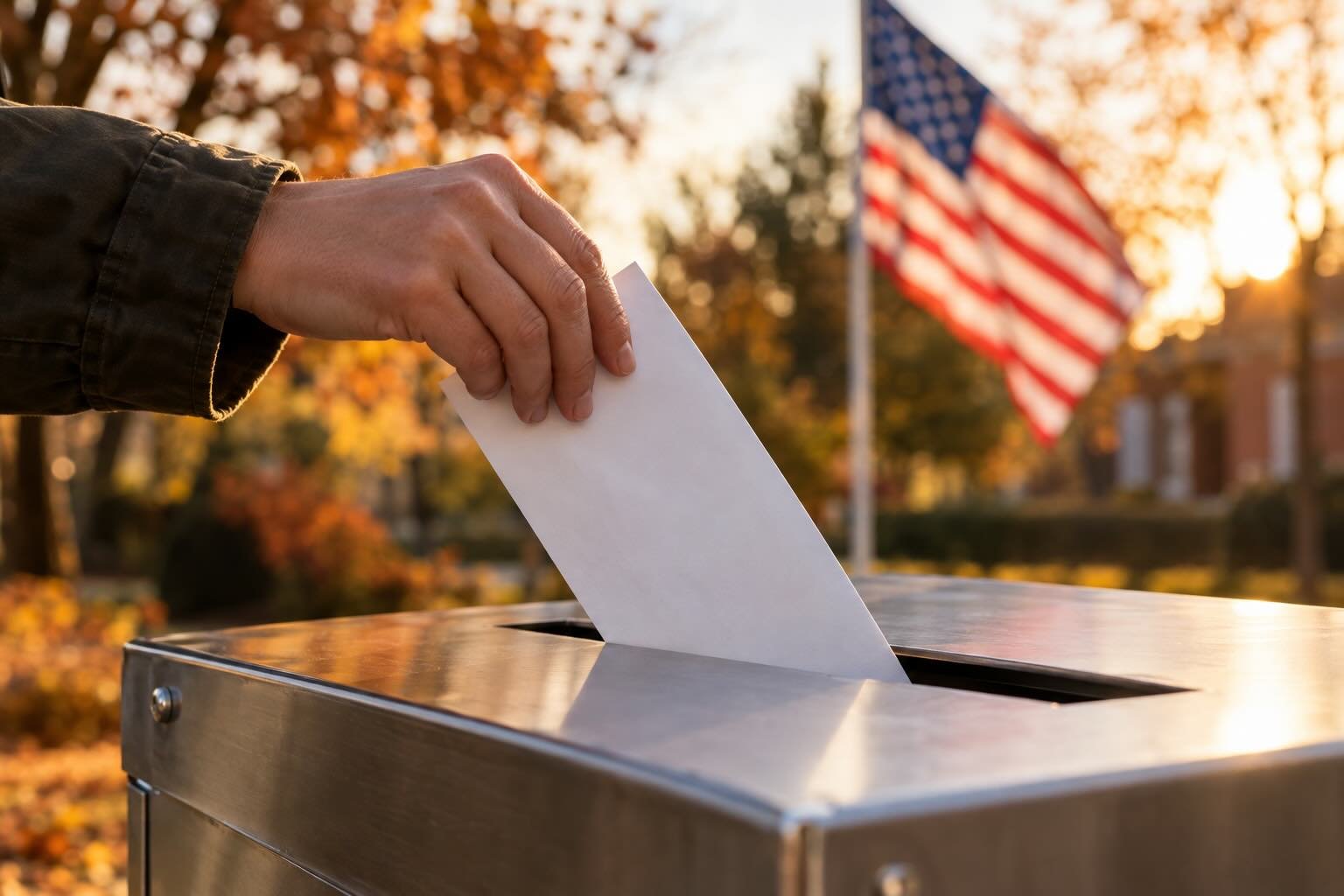
Six years ago in October of 2020 I posted a blog about the importance of voting in that year of COVID. Despite the extra precautions needed because of the pandemic, we had just taken advantage of early voting to get our voice heard. In that article I wrote that I never feel so patriotic and American as I do when I vote, whether National or local, Presidential or midterm.
Now here we are in 2026 in what is arguably one of the most important midterm elections of my lifetime. This time once more we are facing potential problems caused not by a disease of the body, but a disease of the body politic.
The Problem
Let’s not sugarcoat this one. Heading into the 2026 midterms, “election administration” is starting to sound less like a civics class term and more like something out of a wartime briefing. There have been reports and even outright floated proposals about deploying National Guard troops or federal agents to polling places — which, for the record, is illegal under multiple federal laws designed specifically to prevent voter intimidation, no matter who’s floating the idea. Voting rights organizations have documented aggressive efforts to purge eligible voters from the rolls, often using outdated or unreliable data that disproportionately catches naturalized citizens and other legitimate voters in the net — sometimes without so much as a postcard telling the voter it happened.
On top of that, we’re seeing polling places consolidated or hours trimmed in ways that conveniently make voting less convenient for exactly the people who have the hardest time getting there in the first place. And mail-in voting — which millions of Americans, including plenty of seniors and folks with mobility issues like my first wife dealt with — has become a political football, with threats to slow it down, restrict it, or throw legal obstacles in its path.
There are unsupported claims of wide-spread voter fraud, proffered bribes and pleas from the President to “cheat like hell”, and suggestions to declare martial law on Election Day.
None of this is a conspiracy theory. It’s documented, it’s being litigated, and it’s exactly why showing up informed and prepared matters more this cycle than it has in a long while.
Confirming Your Voter Registration
The good news is that checking your registration takes about two minutes and doesn’t require calling anybody or standing in a line. Vote.org (or go directly to vote.org/am-i-registered-to-vote) is a well-established, nonpartisan tool that lets you check your status by state in just a few clicks — it’ll also tell you if something looks off, like an address mismatch. Your state’s own Secretary of State website will have an official registration lookup tool as well, and that’s really the gold-standard source since it’s pulling directly from the state’s voter file rather than a third party. Vote411.org, run by the League of Women Voters, is another solid, nonpartisan option that also gives you personalized ballot information once it confirms you’re registered. Given everything in the news about voters getting quietly removed from the rolls, I’d say this step isn’t optional this year — check now, not the week before the election, so you’ve got time to fix anything that’s gone sideways. Likewise, if you have a separate Voter ID card, check weeks ahead of time to make sure the information on it is accurate.
Get a Sample Ballot
Speaking of personalized ballot information, be sure to use that Vote411.org site to see exactly what is on your ballot. Many states will include ballot initiatives, state constitution changes, and other local issues. These can be worded in a complicated and stilted manner, making it sometimes difficult to understand when standing in the voting booth.
For example, in our own state of Tennessee, one proposed Constitutional Amendment reads “That all prisoners shall be bailable by sufficient sureties, unless for capital offences, when the proof is evident, or the presumption great. And the privilege of the writ of Habeas Corpus shall not be suspended, unless when in case of rebellion or invasion, the General Assembly shall declare the public safety requires it.”
Regardless of how you feel about that statement, a more careful read shows that the vote is not on that statement per se, but instead is on whether to delete that wording and replace it with something else. The new proposed wording goes on for several paragraphs and a bullet list, so again, best to have some time to read and understand the questions, even do some research, before committing your vote.
Your Best Option is Early Voting: Finding Dates and Locations
Early voting is by far your best insurance policy against a bad Election Day. We have done this in the last few elections, and will do so again in mid-October when Early Voting begins here in Tennessee. No problem with long lines, bad weather, a car that won’t start, or whatever else that might stop you from voting. If something goes wrong on one day, you’ve still got others. Availability and dates vary a lot by state (some offer weeks of early voting, a handful offer none at all), so the fastest way to find your specific window is through your state or county election office’s website — a quick search for “[your state] early voting” will usually get you there directly. Vote.org again earns its keep here, with an early voting lookup tool that pulls together dates and locations by state in one place. Your county election office or Secretary of State’s office can also tell you which specific locations near you are open for early voting, since it’s not always the same building as your regular Election Day polling place. If you can vote early, do it. It takes the pressure off everybody, including the poll workers, and you are much less likely to run into people trying to stop or intimidate your vote.
Making Sure Your Mail-In Vote Is Counted
Here’s the mail-in ballot myth I see a lot on social media, and I wanted to run it down before repeating it: the idea that slapping a stamp on your ballot somehow “upgrades” it to First-Class treatment. Turns out that’s not really how it works. Ballot Mail is already handled as First-Class Mail by USPS policy, regardless of whether the envelope needs a stamp or arrives postage-paid (a lot of jurisdictions provide prepaid return postage anyway). So the stamp isn’t what’s protecting your vote — the classification already does that. What actually matters is timing: mail your ballot back at least a week before Election Day if you can, since some states count ballots that arrive after Election Day only if they’re postmarked by Election Day, and postmarks don’t always perfectly capture the exact date and time USPS took custody of the envelope. If you’re cutting it close, take your completed ballot inside your local post office and ask for a manual postmark, which gives you a clean paper trail. And once it’s mailed, most states now offer ballot tracking online (same idea as tracking a package) so you can confirm it was received and accepted rather than just hoping it arrived.
Ballot Drop Boxes: Safety and How to Find Them
Drop boxes are a legitimate, secure alternative to mailing your ballot, and in most states they’ve been used for years without the kind of problems that get whipped up in social media rumors. They’re monitored, often under video surveillance, and collected by election officials on a regular schedule. Using an official drop box run by your county or state election office is generally considered just as secure as handing your ballot to a mail carrier, and it skips the mail system entirely, which some people prefer if they’re worried about timing. To find official drop box locations near you, go straight to your county election office’s website or your Secretary of State’s election page — they’ll have an interactive map or list of approved locations. I’d steer clear of any unofficial-looking box or “ballot collection service” that isn’t listed on a government website; if it’s not on your county’s official list, don’t use it.
What to Have Ready Before You Vote
A little preparation saves you a lot of standing around scratching your head in line. Bring a valid government-issued photo ID if your state requires one for in-person voting (or even if they don’t, just to be safe). If you have been issued a Voter ID, make sure the information on it is correct and bring it with you. Requirements vary quite a bit state to state, so check your Secretary of State’s website in advance rather than assuming. Know your polling place address ahead of time (it sometimes changes between elections, especially if there’s been any consolidation). If you’re referring to a sample ballot or bringing notes on candidates and measures you’ve researched, that’s generally allowed. Most states let you bring in your own notes or a marked-up sample ballot, you are just not allowed to show it to other voters or take a photo of your marked ballot inside the polling place, since that can run afoul of ballot secrecy laws.
And build in a little extra time. If lines are long or something’s not working right when you get there, you want the flexibility to wait it out rather than needing to be somewhere else in fifteen minutes.
If You’re Told You’re Not on the List
This is the one everybody should know, because it’s federal law, not a courtesy: if you show up to vote and you are told your name isn’t on the rolls, you have the right under the Help America Vote Act (HAVA) to request and cast a provisional ballot. Don’t let a poll worker talk you out of it or send you away. That right exists specifically because voter rolls can get things wrong, sometimes through simple clerical errors and sometimes, as we talked about earlier, through more deliberate purges.
Your provisional ballot gets set aside and your eligibility is verified afterward; if it checks out, your vote counts like any other. Every state also has a process for you to follow up and confirm whether your provisional ballot was ultimately counted — take the paperwork they give you at the polling place, because that’s usually how you check status afterward. If you believe you were wrongly removed from the rolls or denied a provisional ballot outright, organizations like the Election Protection hotline (866-OUR-VOTE) exist specifically to help voters in that situation in real time, on Election Day.
Also Worth Knowing
A few last things worth tucking in here. First, the nonpartisan Election Protection coalition’s hotline (1-866-OUR-VOTE)is worth saving in your phone before Election Day, not after something’s already gone wrong. They field everything from “my polling place moved” to “someone’s trying to intimidate voters outside my precinct,” and they’re staffed by people who actually know election law.
Second, if you see or experience anything that feels like intimidation at a polling place, such as uniformed personnel who aren’t election officials, aggressive behavior, anything that doesn’t feel right, you can and should report it; poll workers and election officials have protocols for exactly this, and you don’t have to just quietly leave.
Third, if you’re helping an elderly parent, a spouse, or anyone with a disability navigate any of this (registration, early voting, drop boxes) most states have specific accommodations and assistance provisions, so it’s worth checking your state’s rules rather than assuming you can’t help.
And finally: whatever else changes between now and Election Day, the fundamentals don’t. You have the right to vote, the right to a provisional ballot if there’s a dispute, and the right to cast that vote without somebody in a uniform standing over your shoulder. Don’t let the noise surrounding this election talk you out of showing up. Vote, and get your vote counted.


Leave a Reply